
Are all men freaks?
Season 2, Episode 3
Carrie’s Column answers every question Carrie Bradshaw ever asked in Sex and the City, like exactly how powerful was beauty? And how often is normal? Layered with nuanced life experiences in the form of interviews, think pieces, and amusing anecdotes about shitty ex-boyfriends.
Somewhere along a country road near Chipping Norton, Matt asked me to turn the music down and stop singing. I was so angry I could have opened the car door and thrown myself into the bushes.
I stared out the window, sulking, and moved my knee away when he put his hand on it. He was suppressing my feminine joy, and I wanted to punish him for ruining our weekend away.
Maybe I need to reject the traditional roles that exist in our relationship, I thought. Maybe I’ll lift the heavy boxes when we come to move, or get under the sink and fix whatever’s leaking. Meanwhile, he could ask me if I still love him once in a while. Why does he never ask me?
I took to TikTok once, sharing my interest in the differences between feminine and masculine energy. The video had been up for only ten minutes before I was called a misogynist.
To me, masculine and feminine energy are two things that coexist, I explained in the comments. “And masculinity doesn’t necessarily mean men, whilst femininity isn’t intrinsically linked to women. My partner, for example, has many aspects that lean towards feminine energy. Like empathy and emotional intelligence.” I should have stopped there.
“But also,” I continued, “there’s plenty of space for men to be masculine and women to be feminine. Sure, we now recognise gender and sexuality as fluid, but those traditional roles still hold for many. Does that belief really make me a misogynist?”
You’re a misogynist, just like all men, they replied. The theory was rejected, and TikTok had spoken. I, alongside men, am an enemy, an antagonist, a freak.
Recently, women across social media were being taught how to be the ‘Black Cat’ in their relationship, whilst seeking a male partner who’s the ‘Golden Retriever’. This theory is—apparently—the basis of any successful relationship. It’s suggested that one Black Cat and a Golden Retriever are where both parties are the most secure and happy.
Whilst I take this concept with a heavy pinch of salt (and have to ignore the multitude of different types of relationships that exist outside of x1 man and x1 woman), I understand the basic foundations of it. It’s not worlds away from the one I was coined a misogynist for.
I do, however, think the rhetoric and messaging surrounding this theory are harmful. You are the muse; he is an accessory. You are the star; he is a fan. You are a goddess; he is just there. You are glowing, and he just exists.
What I hear when women use language like this—when they say things like men are misogynists, men should be your accessory, men are freaks—I see women who’ve been hurt. Maybe by an absent father, an alcoholic brother, an abusive partner, or even the idiot who simply fell out of love with us. Regardless of who caused it, this disdain is being driven by an abandonment wound, and abandonment leads to self-sabotage. Fight me on it if you want, but I will die on this hill.
If a man you relied on left you, scared you, or let you down, it makes sense that faith in men would decline. At some point, deciding love is unreliable feels smarter than admitting you want it, and detachment becomes the safer option. You pull back before anyone gets too close. You roll your eyes at tradition, at marriage, at the idea of building something long-term, because what if it falls apart—again.
We see this very thing play out in this episode. Carrie’s dating a sweet man, but because she’s been burned in the past, she’s convinced herself he’s a freak with a deep, dark secret. With a cigarette in hand, she tears his home apart after he leaves to play soccer (football)—trying to find something, anything, so she can say “I told you so”. In the end, she doesn’t find anything, besides regret and a moment of deep self-reflection.
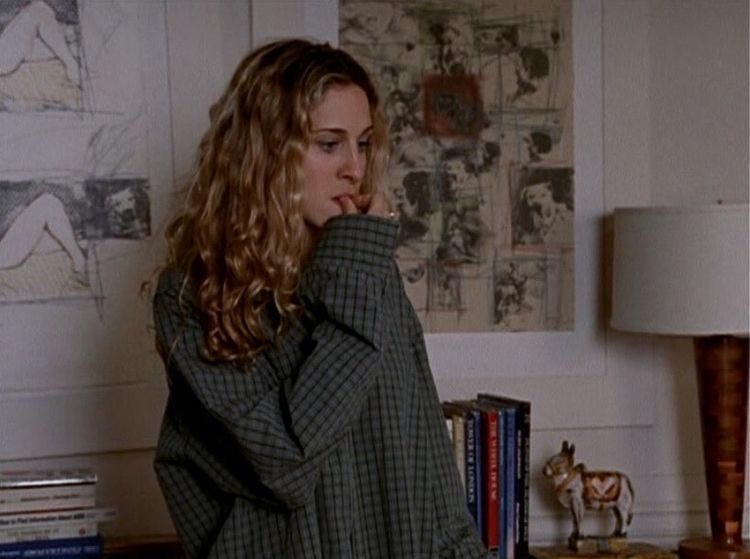
Her pain is valid—but it’s a poignant episode for women to interrogate their own codependence and fear of abandonment, working out what safety means to them and whether it’s something they’ve ever really felt.
When I lived in West London, I was on my way to get a morning coffee with someone I was newly dating. A pigeon flew straight towards us, and my date darted behind me, using me as a human shield. We couldn’t stop laughing. His inability to defend me was hilarious. But in that post-laugh, sighing haze, I knew I wanted more. I craved protection and safety. I reasoned that if abandonment was my greatest fear, then security was going to be my greatest value, and inevitably, we parted ways.
Then I met Matt, who healed me so hard, “I started liking pink again.”—The Internet
Over the years, we’ve sewn the pieces of my weak, abandoned heart back together. His safety and security let me step into my femininity. I didn’t have to protect men from pigeons anymore! His masculinity helped heal me. He’s not interested in making decorative bows for the Christmas tree on December 1st, but we could be dropped in the middle of the Guinean Forests of West Africa, and he’d know exactly how to get us home. We’ve embraced traditional gender roles that feel instinctive, not oppressive. My softness and intuition complement his decisiveness and protection.
Sometimes he walks faster than me, and I’ll shout from behind, “I’ll just meet you at home then!!” The Internet calls this a red flag and narcissistic behaviour on his part, which is hilarious to me because the man has never even taken a selfie. We just have different walking paces, and I slow down to peep in people’s windows.
Back in Chipping Norton, I thought about my conversations with those strangers on TikTok, and how maybe I could’ve explained it better. I wish I’d told them I understand what it feels like to have no faith in men, and how I once thought they were all freaks, too. But I wish I’d also told them that for some people, those traditional dynamics are a structure you can lean against when your bones are soft from grief.
I’d tell them that some men are freaks, but most aren’t. Most are normal, wobbly humans who feel insecure after a bad haircut, replay awkward moments in their heads, and needlessly worry about not being liked. They grew up loving their mums, resisting her hugs but slipping on her shoes to help bring in the shopping. They, too, feel shy about their bodies and cry when things go wrong. Only a few are cigar-breathed, sex-trafficking misogynists.
Matt didn’t ask me to stop singing in the car to suppress my joy. He asked me to stop singing so he could concentrate on the narrow roads and keep me safe. He’d never throw me to the pigeons, so I let him put his hand back on my knee.
I’ve been thinking about my belief that it is unhealthy to find a man to heal me. Of course, I am responsible for my own emotional health, but reading this has me wondering…if weak men have broken me over and over again, maybe a strong man can help me fix my beat up little heart. Maybe I don’t have to do it all by myself.
I adore your writing so much Laura ❤️so insightful and fun.